
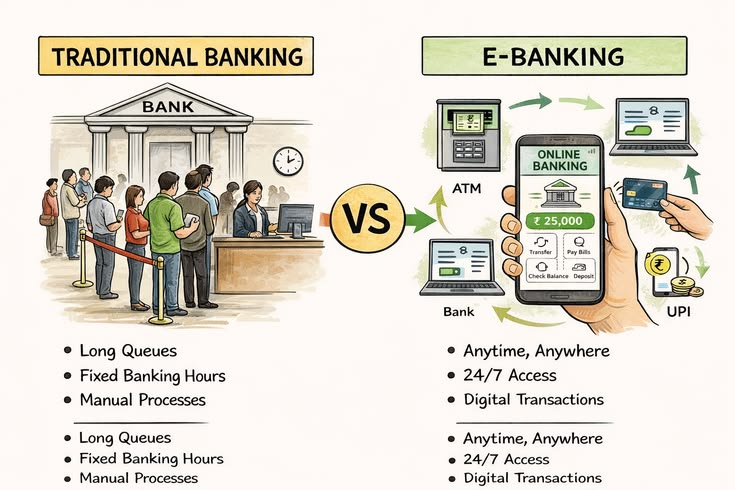
Banking has changed significantly over the years. In the past, people often had to visit a bank branch to deposit money, transfer funds, check their balances, or resolve account issues. Today, many of these activities can be completed using a smartphone, computer, or tablet.
This shift has created two common banking options: digital banking and traditional banking. Both offer ways to manage money, make payments, save, and access financial services, but they differ in how customers interact with their banks.
Digital banking emphasizes convenience and online access, while traditional banking typically provides physical branches where customers can receive in-person assistance. Understanding the advantages and disadvantages of each can help you choose the option that best suits your lifestyle, financial needs, and personal preferences.
1. What Is Digital Banking?
Digital banking refers to banking services that customers access electronically through mobile applications, websites, and other digital platforms.
These services allow customers to perform many everyday financial activities without visiting a physical branch.
For example, you may be able to open an account, transfer money, pay bills, purchase airtime, review transactions, and manage savings through your bank’s mobile application.
Some digital banks operate primarily online, while traditional banks also offer digital services through their mobile apps and websites.
Digital banking has become popular because it allows people to manage their finances from almost anywhere with a reliable internet connection and a compatible device.
Advantages of Digital Banking
Convenience and accessibility
One of the biggest advantages of digital banking is that you can access many banking services without traveling to a branch.
Whether you are at home, at work, or traveling, you can check your balance, transfer money, or pay bills whenever the service is available.
This convenience can be particularly useful for people with busy schedules or those who live far from bank branches.
Faster transactions
Many digital banking services process transactions quickly. Transfers between supported accounts, bill payments, and other routine activities can often be completed within minutes.
However, processing times depend on the banks involved, payment networks, transaction limits, and security checks.
Potentially lower fees
Some digital banking providers offer competitive fees, reduced account maintenance charges, or other cost-saving features because they rely less on physical branches.
Nevertheless, digital banking is not automatically cheaper. Transfer charges, withdrawal fees, exchange rates, and other costs vary by provider.
Easy money management
Digital banking applications often include transaction histories, spending summaries, balance notifications, and payment reminders.
These tools can help customers monitor spending, identify unusual transactions, and maintain better financial habits.
Disadvantages of Digital Banking
Despite its advantages, digital banking has limitations.
First, customers may need a reliable internet connection, a compatible device, and access to their registered phone number or authentication method.
Technical problems, service outages, or network interruptions can temporarily prevent access to certain services.
Second, digital banking can expose customers to risks such as phishing, fraudulent applications, identity theft, and social engineering.
Customers must protect their passwords, use strong authentication methods, and avoid sharing one-time passwords or personal identification numbers.
Finally, some customers may find it difficult to resolve complicated problems through automated systems or online customer support.
2. What Is Traditional Banking?
Traditional banking generally refers to banking services provided through physical branches, where customers can speak directly with bank employees and complete transactions in person.
Traditional banks may offer savings accounts, current accounts, loans, mortgages, investment products, and other financial services.
Many also provide ATMs, telephone banking, online banking, and mobile applications. Therefore, traditional banking does not necessarily mean avoiding technology.
Its defining feature is the availability of physical branches and face-to-face assistance.
Advantages of Traditional Banking
Personal assistance
One major benefit of traditional banking is the opportunity to speak directly with bank staff.
This can be helpful when applying for a loan, resolving account problems, discussing financial products, or addressing complicated transactions.
Some customers prefer explaining their circumstances to a person rather than navigating an application or automated support system.
Support for complex transactions
Certain financial activities may require document verification, signatures, additional checks, or specialized assistance.
Although many banks now support these activities digitally, a branch can be useful when a transaction cannot be completed online.
Access to a wider range of services
Depending on the institution, traditional banks may provide services that require specialist support, including business banking, complex lending arrangements, cash handling, and financial consultations.
However, some digital banks also provide extensive financial products, so the available services depend on the individual provider.
Cash deposits and withdrawals
Physical branches can be useful for customers who frequently handle cash, particularly businesses that receive cash payments.
Branch availability, opening hours, and cash-handling policies vary between institutions.
Disadvantages of Traditional Banking
Traditional banking can be less convenient for everyday transactions that require visiting a branch.
Traveling to a branch takes time and may involve transportation expenses, queues, and waiting periods.
Branch opening hours can also restrict access to in-person services, especially for people who work during normal business hours.
Some traditional banking products may include account maintenance fees or other charges, although this varies by institution.
Additionally, customers who live in rural areas or underserved communities may have limited access to nearby branches.
3. Digital Banking vs. Traditional Banking: Key Differences
The following comparison highlights the main differences between the two approaches.
Accessibility: Digital banking allows customers to access many services remotely, while traditional banking offers in-person access through physical branches.
Speed: Digital transactions can be completed quickly, although processing times depend on the service. Branch transactions may require travel and waiting.
Customer support: Digital banks may provide support through chat, email, telephone, or in-app messaging. Traditional banks may offer face-to-face assistance alongside digital support.
Costs: Digital providers may have lower fees for some services, but neither banking model is always cheaper. Compare the actual charges before opening an account.
Security: Both models face security risks. Digital banking requires careful protection of devices and login credentials, while traditional banking also involves risks such as fraud, identity theft, and unauthorized transactions.
Cash access: Traditional branches can be useful for handling large cash deposits or specialized cash transactions. Digital banks may rely on ATMs, agents, transfers, or partner networks.
Technology requirements: Digital banking depends more heavily on access to suitable technology, while branch banking can provide an alternative when customers cannot use digital services.
Neither option is universally superior. The better choice depends on which services you need and how you prefer to manage your finances.
4. Which Option Is Better for You?
Choosing between digital and traditional banking becomes easier when you consider your daily routine and financial priorities.
Digital Banking May Be Better If You:
- Prefer managing your finances using your phone.
- Frequently transfer money or pay bills electronically.
- Want quick access to account balances and transaction histories.
- Prefer convenient services that do not require branch visits.
- Are comfortable using digital tools and following online security practices.
For example, a freelancer who receives payments electronically and pays most expenses online may find digital banking particularly convenient.
Traditional Banking May Be Better If You:
- Frequently deposit or withdraw cash in person.
- Prefer face-to-face customer support.
- Need help with complex financial transactions.
- Want access to branch-based services.
- Feel more comfortable discussing certain financial matters with bank employees.
For example, a business owner who regularly deposits cash and needs assistance with business financing may benefit from maintaining an account with a bank that has accessible branches.
5. Is It Better to Use Both?
For many people, the best solution is not choosing one option exclusively. It is using digital and traditional banking together.
You might maintain an account with a traditional bank for cash deposits, specialized services, or access to branch support while using a digital banking account for everyday transfers and spending.
This arrangement can provide flexibility, particularly when one provider experiences technical problems or does not offer a service you need.
However, maintaining multiple accounts may involve additional fees, minimum balance requirements, and more complicated money management.
Before opening another account, consider whether the benefits justify the extra costs and effort.
It is also wise to check whether each institution is properly licensed and whether eligible deposits receive protection under the applicable deposit insurance scheme in your country.
6. How to Choose a Safe and Reliable Banking Provider
Regardless of which banking model you choose, safety and reliability should be priorities.
Start by checking whether the bank or financial institution is authorized by the relevant financial regulator.
Next, compare account fees, transaction limits, withdrawal options, customer support availability, and the process for reporting fraud.
Review the provider’s security features. These may include transaction alerts, biometric authentication, multi-factor authentication, and the ability to freeze a card or account when necessary.
Never share your password, PIN, or one-time verification code with someone who contacts you unexpectedly. Avoid clicking suspicious banking links, and access your account through the official application or website.
Finally, consider how easily you can get assistance if a transfer fails, your account is restricted, or you lose access to your phone.
A convenient banking service is valuable, but reliable support and effective security are equally important.
Conclusion
Digital banking and traditional banking both offer valuable benefits. Digital banking stands out for convenience, accessibility, and the ability to complete everyday transactions remotely. Traditional banking remains useful for face-to-face support, cash handling, and certain complex financial services.
The best option depends on your lifestyle, location, financial needs, and comfort with technology.
If you value speed and flexibility, digital banking may be the better fit. If you prefer personal assistance or regularly need branch services, traditional banking may suit you better. For many customers, combining both options offers the greatest flexibility.
Ultimately, the best bank is not necessarily the one with the newest technology or the most branches. It is the one that helps you manage your money safely, affordably, and conveniently.