
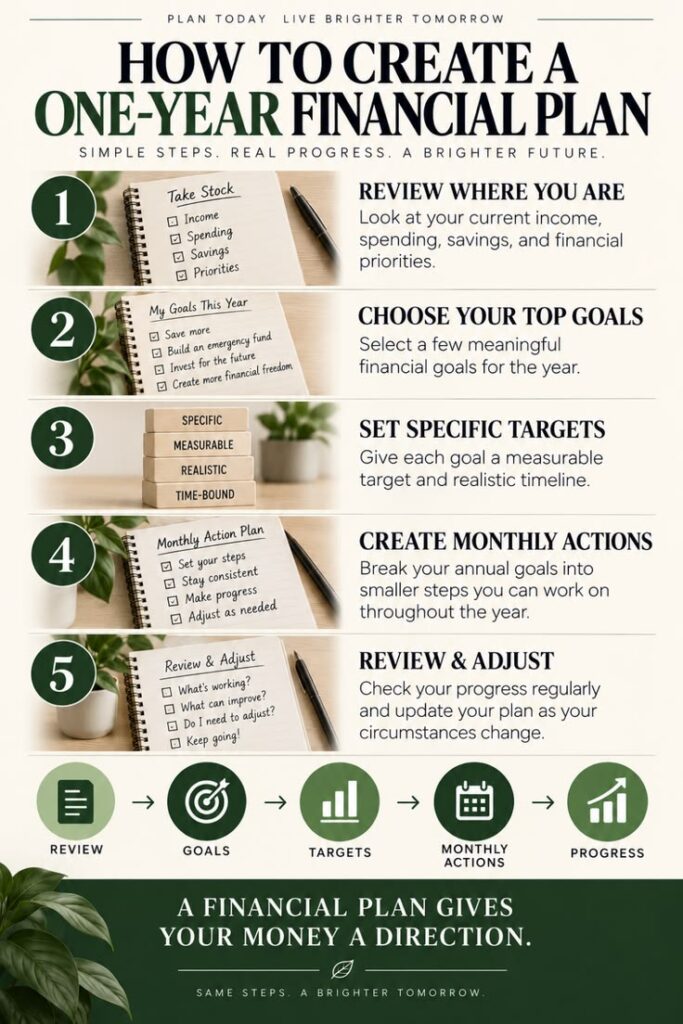
Creating a financial plan for the next 12 months is one of the best ways to take control of your money, reduce financial stress, and make progress toward your goals. Whether you want to save more, pay off debt, start investing, build an emergency fund, or simply stop wondering where your money goes every month, having a clear plan can make a significant difference.
Many people begin the year with good financial intentions but struggle to maintain them because they lack a practical strategy. They may want to save more money without setting a target, spend less without tracking expenses, or pay off debt without deciding how much to contribute each month.
A successful financial plan does not need to be complicated. It requires understanding your current financial situation, setting realistic goals, organizing your income, and reviewing your progress regularly.
Here is how to create a financial plan that works for you over the next 12 months.
1. Evaluate Your Current Financial Situation
Before planning for the future, understand where you stand today. Review your income, expenses, savings, debts, and existing financial commitments.
Start by calculating your total monthly income. Include your salary, business profits, freelance earnings, and other reliable sources of income.
Next, list your monthly expenses. Separate essential costs, such as rent, food, transportation, utilities, and healthcare, from nonessential spending, such as entertainment, impulse purchases, and subscriptions.
Then, calculate your total savings and outstanding debts. Include loan balances, credit card debt, and money borrowed from other people.
This exercise gives you a clear picture of your financial strengths and challenges.
For example, you may discover that you earn enough to cover your expenses but spend too much on unplanned purchases. Alternatively, you may realize that your income is insufficient to cover your essential expenses comfortably.
Understanding the problem helps you choose the right solution.
2. Set Clear Financial Goals for the Next 12 Months
Once you understand your current situation, decide what you want to achieve over the next year.
Your goals should be specific, measurable, realistic, and connected to a timeline.
Instead of saying, “I want to save more money,” establish a clear target, such as saving ₦240,000 within 12 months.
That goal translates to ₦20,000 per month, assuming you start from zero and make consistent contributions without withdrawals or interest.
Your financial goals might include:
- Building an emergency fund.
- Paying off a personal loan or credit card balance.
- Saving for rent, education, or a major purchase.
- Starting a small business.
- Beginning a long-term investment plan.
- Increasing your income through career development or additional work.
Avoid setting too many goals at once. Choose two or three priorities that matter most to you.
If you have expensive debt or no emergency savings, those may deserve attention before taking substantial investment risks.
3. Create a Monthly Budget
A budget is the foundation of your financial plan because it helps you decide how to use your income.
Start by calculating how much money you receive each month. Then assign your income to essential expenses, debt repayments, savings, and personal spending.
One possible starting point is the 50/30/20 budgeting rule:
- 50% for needs: Housing, food, transportation, utilities, and other essential expenses.
- 30% for wants: Entertainment, dining out, hobbies, and nonessential purchases.
- 20% for savings and debt repayment: Emergency savings, financial goals, and additional debt payments.
These percentages are guidelines rather than strict rules. If your rent or other essential costs are high, you may need to adjust them.
For example, someone earning ₦250,000 monthly might initially allocate ₦125,000 to needs, ₦75,000 to wants, and ₦50,000 to savings and debt repayment.
If those amounts do not reflect your actual living costs, create a more realistic budget rather than forcing yourself to follow an unsuitable formula.
The objective is to spend intentionally and ensure that your financial priorities receive consistent attention.
4. Build an Emergency Fund
An emergency fund protects you against unexpected expenses, such as urgent repairs, medical bills, temporary unemployment, or delayed income.
Without emergency savings, you may have to borrow money or use funds intended for other important goals when an unexpected expense arises.
If you do not have an emergency fund, start with a manageable initial target. This could be enough to cover one urgent expense or a portion of your essential monthly costs.
Over time, work toward saving enough to cover three to six months of essential expenses, adjusting the target to reflect your income stability, family responsibilities, and other circumstances.
For example, if your essential expenses total ₦150,000 monthly, three months of expenses would equal ₦450,000.
You do not have to save the entire amount immediately. Consistent contributions can help you build the fund gradually.
Keep emergency savings accessible and separate from everyday spending money. Choose an appropriate account or savings option that balances accessibility, security, and any relevant fees.
5. Develop a Debt Repayment Strategy
If you have outstanding debt, include a repayment plan in your 12-month financial strategy.
Begin by listing each debt, its outstanding balance, interest rate, minimum payment, and due date.
Continue making required payments where possible, then decide how to direct any additional money.
The debt avalanche method prioritizes the debt with the highest interest rate. This can reduce the total interest paid.
The debt snowball method prioritizes the smallest outstanding balance. Clearing smaller debts can provide a sense of achievement and help maintain motivation.
Choose the approach that best suits your financial situation and ability to remain consistent.
Avoid taking on unnecessary new debt while repaying existing balances. If your payments are unaffordable, contact your lenders to discuss possible repayment arrangements before the situation becomes more difficult.
6. Create a Savings and Investment Plan
Saving and investing can help you prepare for both short-term expenses and long-term goals, but they serve different purposes.
Savings are generally suitable for money you may need soon, including emergency funds and planned expenses.
Investments are intended to help grow money over time, but their value can fluctuate, and you may lose some or all of the money invested.
Before investing, establish an emergency fund appropriate to your circumstances and address high-interest debt where practical.
Next, identify your investment goals and time horizon. Research regulated financial products that match your risk tolerance and financial objectives.
Depending on your country, options may include government securities, regulated investment funds, bonds, or diversified stock market investments.
Understand the fees, potential returns, withdrawal restrictions, tax implications, and risks before committing money.
Do not invest money needed for rent, food, school fees, or other essential expenses in volatile assets simply because you want faster returns.
7. Find Ways to Increase Your Income
Reducing unnecessary spending is useful, but there may be limits to how much you can save by cutting expenses alone.
Increasing your income can give you more flexibility to meet essential needs, repay debt, and achieve financial goals.
Consider opportunities to develop valuable skills, negotiate a salary increase, apply for better-paying positions, offer freelance services, or start a small business.
If you already operate a business, review your pricing, operating expenses, customer retention, and opportunities to improve profitability.
However, avoid spending large amounts on unproven business ideas or courses that promise guaranteed income.
Choose opportunities that fit your skills, available time, and financial resources. Any additional income should have a purpose within your financial plan.
For example, you might direct part of the extra money toward debt repayment and another portion toward savings.
8. Prepare for Irregular and Unexpected Expenses
A financial plan should account for more than your regular monthly bills.
Expenses such as annual insurance premiums, school fees, holiday travel, vehicle maintenance, professional renewals, and rent payments can disrupt your budget if you do not prepare for them.
Make a list of major expenses expected over the next 12 months. Estimate their costs and divide each amount by the number of months remaining before payment.
For example, if you expect to pay ₦360,000 for an expense in six months, saving ₦60,000 monthly would help you prepare, assuming you start from zero.
Keep this money separate from your emergency fund so that planned expenses do not interfere with your protection against genuine emergencies.
Planning ahead reduces the need to borrow when large bills arrive.
9. Review Your Financial Progress Every Month
A financial plan should change as your circumstances change.
At the end of each month, review your income, spending, savings, debts, and progress toward your goals.
Ask yourself a few questions:
- Did I stay within my budget?
- Did I save the amount I planned?
- Did my outstanding debt decrease?
- Were there unexpected expenses?
- Do I need to adjust my targets for next month?
If you miss a savings target, identify the reason and make a realistic adjustment. Avoid abandoning your entire plan because one month did not go as expected.
You may also want to conduct a more detailed review every three months to assess whether your goals remain appropriate.
Regular reviews help you identify problems early and recognize the progress you have made.
10. Follow a Simple 12-Month Financial Roadmap
You can organize your financial plan into four stages.
Months 1–3: Build the foundation. Evaluate your finances, create a budget, establish savings habits, and identify your most important goals.
Months 4–6: Strengthen your position. Continue building emergency savings, reduce expensive debt, and address recurring spending problems.
Months 7–9: Expand your progress. Explore ways to increase your income, improve your savings rate, and research appropriate investment options.
Months 10–12: Review and prepare. Calculate your progress, adjust unfinished goals, prepare for upcoming expenses, and create a financial plan for the following year.
This roadmap is flexible. If you have overdue essential bills or serious debt problems, you may need to focus on immediate financial stability before moving toward longer-term goals.
Conclusion
Creating a financial plan for the next 12 months gives you a practical way to manage your money with greater confidence and purpose.
Start by understanding your current finances, setting clear goals, and building a budget that reflects your real expenses. Prioritize emergency savings, develop a debt repayment strategy, and consider suitable ways to increase your income.
Prepare for irregular expenses, learn about investing before taking risks, and review your progress every month.
Most importantly, remember that your financial plan does not need to be perfect. It needs to be realistic enough for you to follow consistently.
Your financial future is shaped by the decisions you make today. With clear goals, manageable steps, and regular reviews, the next 12 months can become a meaningful period of financial progress.
One Comment
Comments are closed.