
Paying off debt can feel stressful, especially when bills keep coming, expenses continue to rise, and your income seems insufficient to cover everything. It is easy to feel discouraged when you make payments every month but still have a large balance remaining. However, paying off debt does not have to mean sacrificing everything you enjoy or living under constant financial pressure.
The key is to create a realistic repayment plan, develop healthier money habits, and focus on steady progress rather than perfection. With the right approach, you can reduce your debt faster while maintaining a balanced and manageable lifestyle.
1. Understand Your Current Financial Situation
The first step toward paying off debt is understanding exactly how much you owe. Avoiding your debt may temporarily reduce your anxiety, but knowing the full picture allows you to make informed decisions.
Write down all your debts, including credit cards, personal loans, unpaid bills, and money borrowed from friends or family. Record the outstanding balance, interest rate, minimum monthly payment, and due date for each debt.
Next, review your monthly income and expenses. Identify how much money you receive, how much you spend on necessities, and how much remains available for debt repayment.
You do not need a complicated spreadsheet or expensive budgeting application. A notebook or simple phone document can work perfectly well.
Understanding your financial situation gives you a starting point and helps you develop a repayment strategy that suits your circumstances.
2. Choose a Debt Repayment Strategy
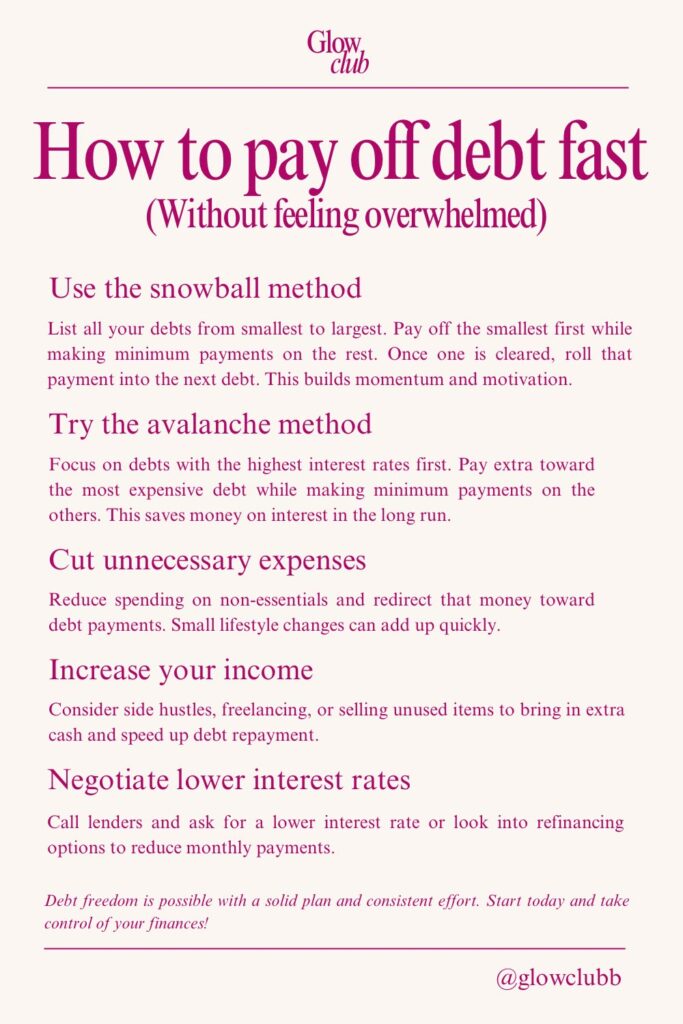
Once you understand what you owe, choose a repayment method that matches your financial needs and personality. Two popular approaches are the debt snowball method and the debt avalanche method.
The debt snowball method involves paying the minimum amount required on every debt while directing any additional money toward the smallest balance. Once that debt is cleared, you redirect its payment toward the next smallest balance.
This approach helps you experience quick wins, which can increase your motivation and confidence.
The debt avalanche method follows a similar process, except you focus on the debt with the highest interest rate first. This method can reduce the total interest you pay and may help you become debt-free at a lower overall cost.
Both approaches can work. If motivation is your biggest challenge, the snowball method may be helpful. If your main priority is minimizing interest, consider the avalanche method.
Whichever approach you choose, remain consistent and continue making the required minimum payments on your other debts whenever possible.
3. Create a Realistic Monthly Budget
A budget helps you decide where your money should go before you spend it. Without a plan, it becomes easy to underestimate small expenses and struggle to find money for debt payments.
Start by listing essential expenses such as housing, food, transportation, utilities, healthcare, and other necessary bills. Include your minimum debt payments as well.
After accounting for these expenses, determine how much you can reasonably contribute toward additional debt repayment.
Avoid creating an extremely restrictive budget that leaves you unable to handle normal expenses. A budget that is too difficult to maintain may lead to frustration, overspending, and abandoning your repayment plan.
Instead, create a budget that balances financial responsibility with everyday needs. Leave room for occasional personal spending and unexpected costs.
Remember that your budget should support your life, not make every day feel like a financial punishment.
4. Find Small Ways to Reduce Spending
You do not necessarily need to make dramatic lifestyle changes to pay off debt faster. Small adjustments can free up money that would otherwise disappear into unnecessary expenses.
Review your spending habits and identify purchases that provide little value. These might include unused subscriptions, frequent impulse purchases, expensive convenience meals, or services you rarely use.
You could prepare meals at home more often, compare prices before shopping, plan purchases in advance, or establish a waiting period before buying nonessential items.
The goal is not to eliminate every enjoyable activity. Instead, focus on spending intentionally.
For example, saving a manageable amount each week and consistently directing it toward your debt can make a meaningful difference over time.
Choose two or three changes that feel realistic rather than attempting to change every spending habit at once.
5. Increase Your Debt Payments Gradually
Making extra payments can help you become debt-free sooner, particularly when you are paying down high-interest debt.
However, you do not need to increase your payments dramatically from the beginning. Start with an amount that fits comfortably within your budget.
Whenever you receive additional income, such as a bonus, commission, gift, or payment from freelance work, consider directing part of it toward your target debt.
You can also explore opportunities to earn additional income through tutoring, freelancing, selling unused possessions, or offering services based on your existing skills.
Before committing extra money, ensure that essential expenses and urgent obligations are covered.
It is also important to understand how your lender applies extra payments. Confirm that additional payments reduce the outstanding principal when appropriate and check whether any early repayment fees apply.
Gradually increasing your payments can help you build momentum without placing unnecessary pressure on your finances.
6. Build an Emergency Fund
One common mistake people make when paying off debt is using every available amount of money to make repayments.
Although this may appear to speed up progress, it can leave you financially vulnerable. If an unexpected expense arises, you may have to borrow again.
To reduce this risk, build a small emergency fund alongside your repayment efforts. Start with an amount you can reasonably afford, then increase it gradually as your finances improve.
Your emergency fund can help cover unexpected transportation costs, urgent repairs, medical expenses, or temporary income disruptions.
The appropriate amount depends on your circumstances, income stability, and essential expenses. Over time, aim to build savings that can cover several weeks or months of necessary living costs.
If you are already struggling to afford food, housing, utilities, or other essentials, prioritize those immediate needs and seek appropriate support before making aggressive extra debt payments.
7. Automate Payments and Avoid New Debt
Consistency becomes easier when you establish a regular payment routine.
Whenever possible, schedule your minimum debt payments around your payday. Set reminders or use automatic payments if you can reliably maintain enough money in your account.
You can also schedule an additional payment toward your target debt after covering essential expenses.
At the same time, try to avoid taking on new debt unnecessarily. Before making a purchase, ask yourself whether it is essential, whether you can afford it, and whether postponing it would be more beneficial.
If you rely on borrowing to cover basic living expenses each month, your budget may need to be adjusted. Look for ways to reduce essential costs where possible, increase income, or negotiate more manageable repayment terms with creditors.
Paying off existing debt becomes more difficult when new balances continue to accumulate.
8. Track Your Progress and Celebrate Small Wins
Debt repayment is a process, and progress may sometimes feel slow. Tracking your balances helps you recognize improvements that might otherwise go unnoticed.
At the end of each month, record how much you owed at the beginning, how much you paid, the interest charged, and your remaining balance.
Celebrate meaningful milestones, such as paying off your first loan, reducing your total debt by ten percent, or completing three months of consistent payments.
Celebrations do not need to be expensive. You could enjoy a favorite home-cooked meal, spend time with friends, or acknowledge your achievement in a journal.
If you experience a difficult month, avoid treating it as a complete failure. Review what happened, adjust your budget, and continue with a manageable plan.
Progress is rarely perfectly linear, and one setback does not erase your previous efforts.
Conclusion
Paying off debt faster without overwhelming yourself requires patience, planning, and consistency. Start by understanding your debts, choosing a repayment strategy, creating a realistic budget, and identifying small opportunities to save money.
Increase your payments gradually, maintain an emergency fund, and avoid unnecessary borrowing whenever possible. Most importantly, track your progress and give yourself room to adjust when circumstances change.
You do not have to solve every financial problem immediately. Focus on the next practical step and build upon it each month.
Financial freedom is not achieved through one perfect decision. It is built through small, consistent decisions that gradually improve your financial situation.