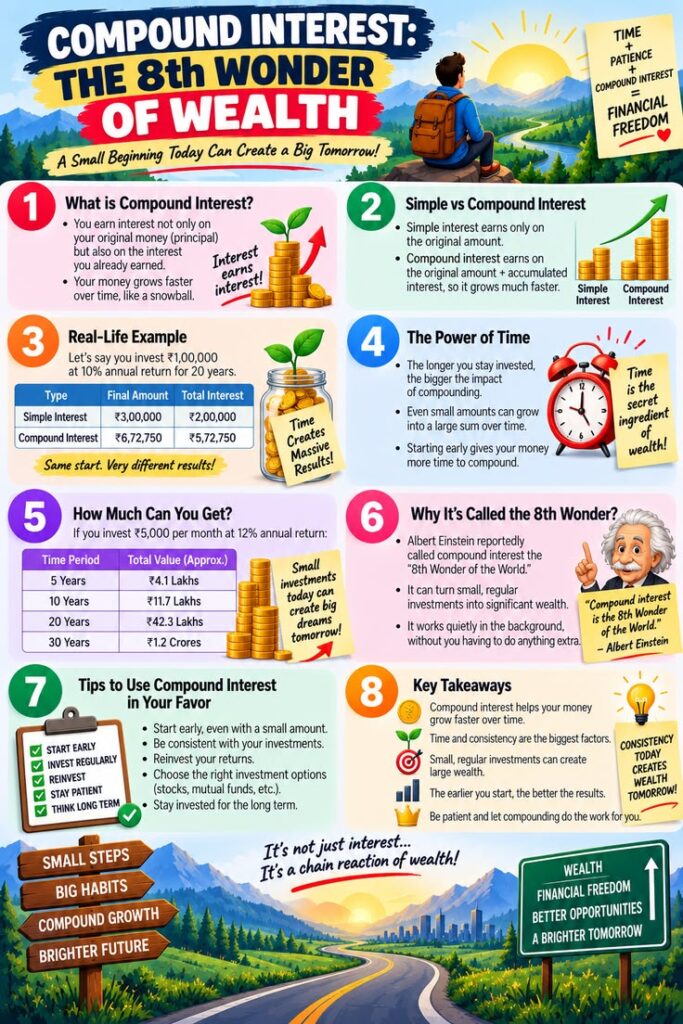
Have you ever wondered how some people gradually build wealth without earning an extremely high income? One important factor is compound interest. It is a powerful financial concept that allows your money to grow over time by earning returns on both your original savings and the returns you have already accumulated.
Understanding compound interest can help you make better financial decisions, develop consistent saving habits, and plan for your future. Whether you are a student, salary earner, business owner, or beginner in personal finance, learning how compound interest works can help you understand the value of starting early and remaining consistent.
1. What Is Compound Interest?
Compound interest is interest calculated on your original amount of money and the interest that has accumulated over time. In simple terms, your money earns returns, and those returns can also begin earning returns.
For example, imagine you save ₦100,000 in an account that earns 10% interest annually. After the first year, you would earn ₦10,000, bringing your balance to ₦110,000.
During the second year, if the full balance earns another 10%, you earn ₦11,000 rather than ₦10,000. Your total becomes ₦121,000.
In the third year, you earn interest on ₦121,000, bringing your balance to ₦133,100.
This process continues as long as returns remain invested and compound. Although the growth may seem slow at first, it can become more noticeable over longer periods.
Actual returns depend on the financial product, fees, taxes, and whether the rate remains constant.
2. How Compound Interest Works
Compound interest works by allowing accumulated returns to become part of the amount that earns future returns. The longer this process continues, the greater its potential effect.
The formula for compound interest is:
A = P(1 + r)ⁿ
Where:
- A represents the final amount.
- P represents the original amount invested or saved.
- r represents the annual interest rate expressed as a decimal.
- n represents the number of years.
For example, if you invest ₦100,000 at an assumed annual return of 10% for five years, with returns compounded annually and no additional contributions, the calculation gives approximately ₦161,051.
Your original ₦100,000 would have grown by ₦61,051 without any additional deposits.
This example assumes a fixed rate and excludes fees, taxes, inflation, and investment losses. Real investment returns are not guaranteed.
3. Why Time Matters So Much
One of the most important lessons about compound interest is that time can make a significant difference.
When you start saving or investing early, your money has more time to accumulate returns and benefit from further compounding. Even modest contributions can become meaningful when you maintain the habit for many years.
Consider two people who invest the same amount at the same assumed annual return. One begins at age 25, while the other begins at age 35. If both plan to stop investing at age 60, the first person has an additional ten years for contributions and accumulated returns to grow.
That extra time can make a substantial difference, depending on the amount invested and the returns earned.
This is why beginning with a small amount today can be more useful than waiting many years until you believe you have enough money to begin.
However, starting early does not guarantee investment success. Your results will depend on your contributions, returns, costs, and the risks you take.
4. The Difference Between Simple and Compound Interest
Simple interest and compound interest are calculated differently.
Simple interest is calculated only on the original principal. Compound interest is calculated on the principal and accumulated interest.
Suppose you have ₦100,000 earning an assumed 10% annually for five years.
With simple interest, you earn ₦10,000 each year, giving you ₦150,000 after five years.
With annual compounding, the balance grows to approximately ₦161,051 over the same period.
The difference is ₦11,051.
Over longer periods, the difference can become much larger because compound interest allows previous earnings to generate additional earnings.
This is why understanding how interest is calculated matters when comparing savings accounts, fixed-income products, and investments.
5. Regular Contributions Can Increase Your Wealth
You do not need a large amount of money to benefit from compounding. Regular contributions can help your money grow because each deposit has the opportunity to earn returns over time.
For example, imagine you contribute ₦10,000 monthly to an investment that earns an assumed average annual return of 10%, compounded monthly. After ten years, your contributions would total ₦1.2 million.
Under these assumptions, the investment could grow to approximately ₦2.05 million, before fees, taxes, inflation, and any variation in returns.
The additional growth comes from investment returns, including returns earned on accumulated gains. Actual results could be significantly higher or lower because investment returns fluctuate.
The key lesson is to develop a contribution habit you can maintain. You can increase the amount as your income grows or your financial responsibilities change.
6. Inflation Can Reduce Your Purchasing Power
Although compound interest can help your money grow, inflation is an important factor to consider.
Inflation means that the prices of goods and services generally increase over time. As prices rise, the same amount of money may buy fewer things than it did previously.
For example, if your savings earn 5% annually while inflation averages 8%, your money may increase in nominal value but lose purchasing power over that period.
This is why it is important to consider the return on your money after accounting for inflation, fees, and taxes.
For short-term needs and emergency funds, safety and accessibility are usually important priorities. For long-term goals, some people consider investments that offer opportunities for growth, while recognizing that higher potential returns generally involve risks.
Choosing the right approach depends on your financial goals and circumstances.
7. How to Start Benefiting from Compound Interest
You can begin applying the principles of compounding by taking a few practical steps.
Start with a realistic amount. Choose an amount you can regularly save or invest without neglecting essential expenses.
Build an emergency fund. Before committing significant money to investments, set aside accessible savings for unexpected expenses.
Be consistent. Make regular contributions whenever your budget allows. Consistency helps you develop a habit and gives your money more opportunities to grow.
Reinvest your returns. Where appropriate, leaving earned interest or investment returns in the account allows them to contribute to future growth.
Understand the product. Check the interest rate, compounding frequency, fees, withdrawal rules, and risks before committing your money.
Be patient. Compound growth usually takes time. Avoid making financial decisions based on promises of quick or guaranteed wealth.
If you are investing in Nigeria, research financial institutions and investment providers carefully, verify applicable regulatory registration, and understand the possibility of losing money.
8. Avoid Common Mistakes
One common mistake is waiting until you earn a large income before beginning to save or invest. Starting with an affordable amount can help you develop good habits while you improve your financial situation.
Another mistake is withdrawing accumulated returns unnecessarily. Frequent withdrawals can reduce the amount available for future compounding.
It is also important not to confuse compound interest with guaranteed profits. Some savings products offer defined interest terms, while investments such as stocks and mutual funds can experience losses. A promised high return with no risk should be treated with caution.
Finally, do not invest money needed for immediate expenses simply because you want to benefit from compounding. Your financial security should come first.
Conclusion
Compound interest demonstrates how money can grow when returns are allowed to accumulate and generate further returns. Its potential benefits become more noticeable over time, especially when combined with regular contributions and patience.
You do not need to start with a large amount to begin building better financial habits. Start with what you can afford, understand the products you use, and remain consistent with your long-term goals.
The most important lesson is that time and discipline can make a difference. By understanding compound interest and applying it wisely, you can take practical steps toward building financial security and preparing for the future.