1. Introduction
Have you ever wondered how a government raises money to build roads, hospitals, schools, and bridges or pay for public services? One way is by borrowing money from individuals, banks, businesses, and other investors.
Two common ways governments borrow money are through Treasury bills and government bonds.
These investments allow you to lend money to the government and receive your money back under agreed conditions. In return, you may earn interest or make a profit, depending on the type of investment.
Treasury bills and government bonds are often considered relatively safe investments, especially when issued by financially stable governments. However, they have different maturity periods, payment structures, and risks.
Let’s explain how they work using simple examples.
2. What Are Treasury Bills?
A Treasury bill, commonly called a T-bill, is a short-term investment issued by a government to borrow money for a limited period.
When you buy a Treasury bill, you are lending money to the government. The government promises to repay the face value of the bill when it matures.
Treasury bills usually mature within one year. Depending on the country, common maturity periods include 91 days, 182 days, and 364 days.
How do Treasury bills work?
Treasury bills are generally sold at a discount. This means you pay less than the amount you will receive when the bill matures.
For example, imagine the government issues a Treasury bill with a face value of ₦100,000.
You purchase it for ₦92,000. After the agreed period, the government pays you ₦100,000.
Your profit is:
₦100,000 − ₦92,000 = ₦8,000.
In this example, you earned ₦8,000 without receiving regular interest payments during the investment period.
The figures are for illustration only and do not represent an actual Treasury bill rate.
Key features of Treasury bills
- Short-term investment: They typically mature in less than one year.
- Discount-based earnings: You generally buy them for less than their face value and receive the full face value at maturity.
- No regular interest payments: Your earnings usually come from the difference between the purchase price and the amount repaid.
- Relatively low risk: The risk of not being repaid depends on the financial strength of the government issuing the bill.
- Suitable for short-term goals: They can be useful if you want to invest money for a few months rather than several years.
Who should consider Treasury bills?
Treasury bills may suit people who have money they do not need immediately but want to invest for a relatively short period.
For example, if you have ₦500,000 that you will need in six months to pay school fees or business expenses, a Treasury bill with a maturity date before the payment deadline might be worth considering.
However, you should always check the maturity date, expected return, taxes, and any fees before investing.
3. What Are Government Bonds?
A government bond is a financial instrument through which a government borrows money for a longer period.
When you purchase a government bond, you lend money to the government. In return, the government agrees to repay the principal amount at maturity and may pay you interest at regular intervals.
Government bonds often have maturities of several years, such as 2, 5, 10, or 20 years, although the available periods vary by country and bond type.
How do government bonds work?
Suppose you buy a government bond worth ₦100,000 with an annual interest rate of 10% and a maturity period of five years.
Assuming the bond is issued at face value and pays a fixed annual coupon, the arrangement works like this:
- You invest ₦100,000.
- The government pays you ₦10,000 in interest each year.
- After five years, you receive the final ₦10,000 interest payment and your ₦100,000 principal back.
Over five years, you receive ₦50,000 in total interest, plus the return of your original ₦100,000.
Your total cash received would therefore be ₦150,000, before taxes, fees, and any other applicable costs.
This example assumes that the government makes every payment as promised. It also ignores the time value of money and inflation.
Key features of government bonds
- Longer investment period: Bonds commonly last several years.
- Regular interest payments: Many bonds pay interest every six months or once a year, although payment schedules vary.
- Principal repayment: The original amount is generally repaid when the bond matures, subject to the government’s ability to meet its obligations.
- Potentially predictable income: Fixed-rate bonds can provide a regular stream of interest payments.
- Possible resale: Some government bonds can be sold to other investors before maturity, although the selling price may be higher or lower than the purchase price.
Who should consider government bonds?
Government bonds may be suitable for investors who want regular income or are planning for long-term financial goals.
For instance, someone saving for retirement may invest in government bonds that mature around the time they expect to need the money.
However, a bond is not automatically the best choice simply because it pays interest. Its maturity date, interest rate, market price, inflation risk, and the investor’s financial needs all matter.
4. The Main Differences Between Treasury Bills and Government Bonds
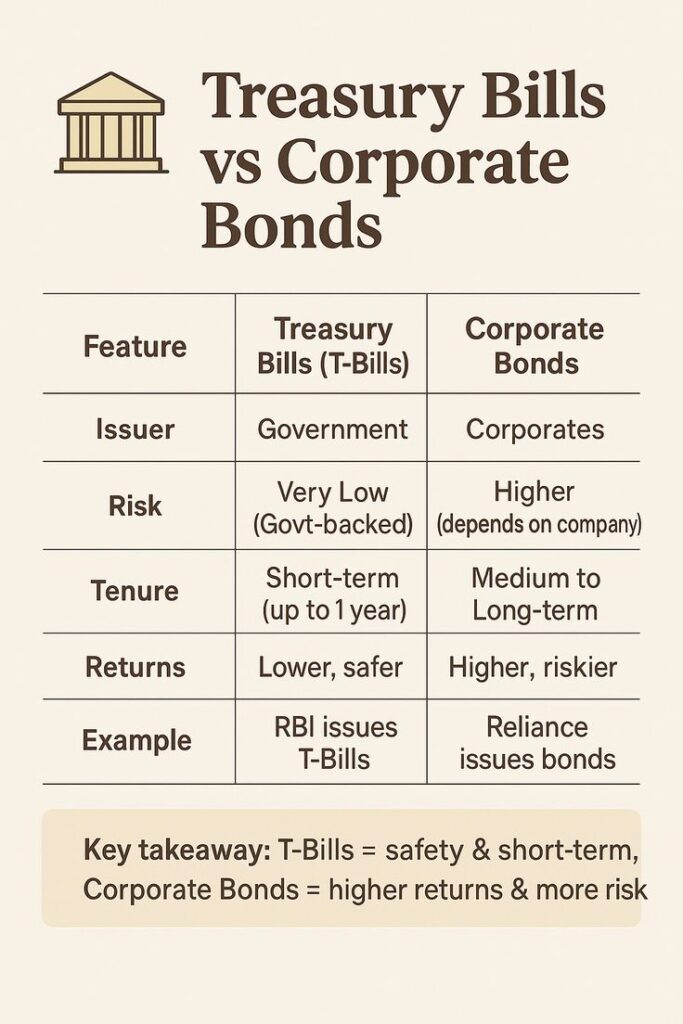
The easiest way to understand the difference is to compare them side by side.
| Feature | Treasury bills | Government bonds |
|---|---|---|
| Investment period | Usually up to one year | Usually several years |
| Earnings | Typically from buying at a discount | Often from regular interest payments |
| Payment structure | Face value paid at maturity | Interest payments plus principal repayment |
| Main purpose | Short-term government borrowing | Longer-term government borrowing |
| Income pattern | Usually no periodic interest | Often periodic interest |
| Price changes | Possible if sold before maturity | Possible if sold before maturity |
| Common use | Short-term savings goals | Longer-term income and investment goals |
The simplest difference: Treasury bills are generally short-term investments, while government bonds are generally long-term investments.
Neither investment is guaranteed to be more profitable than the other. Returns depend on the purchase price, interest rates, maturity period, inflation, and other factors.
5. How Do Treasury Bills and Bonds Make Money for Investors?
Investors can earn money from these instruments in different ways.
A. Through interest or the discount
With Treasury bills, your return usually comes from buying at a discount and receiving the face value at maturity.
With fixed-rate government bonds, you generally receive interest payments according to the bond’s terms.
B. Through selling at a higher price
Suppose you buy a government bond for ₦100,000 and later sell it for ₦105,000.
Your price gain is ₦5,000, excluding transaction costs and any interest received.
However, the opposite can also happen. If market interest rates rise, an existing bond’s market price will generally fall. You could sell it for less than you paid.
This is why selling a bond before maturity can be riskier than simply holding it until its repayment date.
6. What Are the Risks?
Although government securities are often considered relatively safe, they are not entirely risk-free.
Inflation risk
Inflation means the prices of goods and services increase over time.
Imagine you invest ₦100,000 and earn a 10% return over a year. Your investment grows to ₦110,000 before taxes and fees.
However, if prices rise by 15% during that year, your money will buy less than it could have bought at the beginning.
This is called a loss of purchasing power.
Interest-rate risk
When market interest rates rise, the prices of existing fixed-rate bonds generally fall. This matters particularly if you need to sell before maturity.
Default risk
A government may experience financial difficulties and fail to pay interest or repay its debt as promised. The likelihood depends on the issuing government and its financial circumstances.
Liquidity risk
Liquidity refers to how easily you can convert an investment into cash.
Some government securities are easy to sell, while others may have fewer buyers. You might need to accept a lower price to sell quickly.
Currency risk
If you invest in a bond denominated in a foreign currency, exchange-rate movements can affect the value of your returns when converted into your local currency.
7. Treasury Bills and Government Bonds in Nigeria
In Nigeria, Treasury bills and government bonds are important instruments used by the Federal Government to borrow money.
Treasury bills are short-term government securities, while Federal Government of Nigeria bonds are generally longer-term securities.
The Central Bank of Nigeria (CBN) plays an important role in Treasury bill auctions and monetary policy. Government debt management and bond issuance are handled through the relevant government debt-management arrangements, including the Debt Management Office (DMO).
Nigerian investors may be able to access these investments through eligible banks, licensed investment firms, or other authorised channels, depending on the particular security and offering.
Before investing, check the current terms, minimum investment amount, auction results, interest rates or discount yields, maturity dates, taxes, and fees.
You can consult the official websites of the Central Bank of Nigeria and the Debt Management Office for information about Nigerian government securities.
Remember that interest rates change over time. A Treasury bill offering a particular return today may offer a different return at the next auction.
8. Which Is Better: Treasury Bills or Government Bonds?
Neither is automatically better. The right choice depends on your goals.
Consider Treasury bills if:
- You want to invest for a short period.
- You expect to need the money relatively soon.
- You prefer an investment with a defined maturity date within the next year.
Consider government bonds if:
- You want a longer-term investment.
- You prefer regular interest income from a bond that offers periodic coupons.
- You can accept the possibility of market-price fluctuations if you sell before maturity.
Before choosing either, ask yourself three questions:
- When will I need the money? Choose a maturity date that fits your financial plans.
- What return will I actually earn? Consider the yield, taxes, fees, and inflation.
- Can I leave the money invested? Avoid locking up money you may need for emergencies.
It is also sensible to maintain an emergency fund before committing too much money to investments.
9. Conclusion
Treasury bills and government bonds are ways for governments to borrow money from investors.
Treasury bills are generally short-term investments that provide returns through a discount. Government bonds are generally longer-term investments that often pay interest regularly and return the principal at maturity.
Both can play a useful role in a financial plan, but they serve different purposes.
Think of it this way: a Treasury bill is like lending money to the government for a few months, while a government bond is like lending money for several years.
The most important lesson is to understand how long your money will be invested, how your return is calculated, and what risks you are taking before committing your money.
A good investment is not necessarily the one with the highest advertised return. It is the one that fits your financial goals, your time frame, and your ability to handle risk.