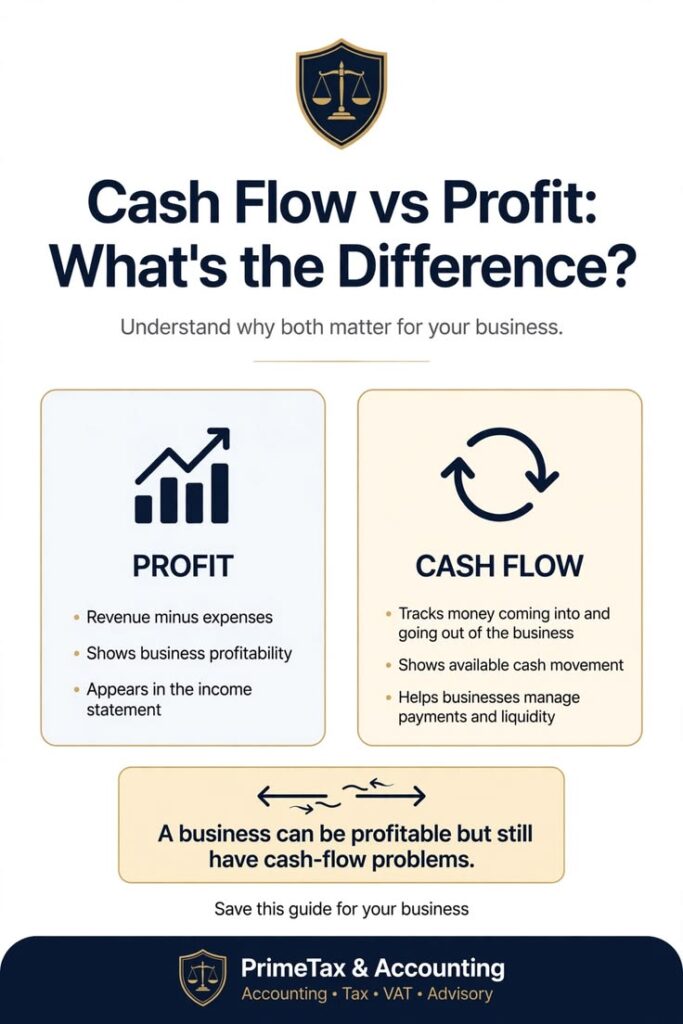
Understanding your business finances is essential if you want to build a successful and sustainable business. Two important financial concepts every business owner should understand are cash flow and profit. Although people sometimes use these terms interchangeably, they mean different things.
A business can make a profit and still struggle to pay its bills. Similarly, a business can have plenty of cash in its bank account temporarily without actually making a profit. Understanding the difference between cash flow and profit helps you make better financial decisions, avoid unnecessary debt, and plan for business growth.
Whether you run a small shop, an online business, a restaurant, or a service-based company, learning how these two concepts work can improve how you manage your money.
1. What Is Cash Flow?
Cash flow refers to the money moving into and out of your business over a particular period.
Money coming into your business is called a cash inflow. Examples include payments from customers, cash sales, loan proceeds, and money invested by the business owner.
Money leaving your business is called a cash outflow. Examples include payments for inventory, rent, salaries, transportation, utilities, and equipment.
When more cash enters your business than leaves it during a period, you have positive net cash flow. When more cash leaves than enters, you have negative net cash flow.
For example, suppose your business receives ₦300,000 in customer payments during a month and pays ₦220,000 in expenses and other cash obligations. Your net cash flow from those transactions is positive ₦80,000.
However, this does not automatically mean your business made ₦80,000 in profit. Some cash payments may relate to inventory not yet sold, equipment purchases, or loan repayments. Similarly, some expenses may have been recorded without an immediate cash payment.
Cash flow focuses on the movement and availability of money.
2. What Is Profit?
Profit is the amount remaining after a business deducts its relevant costs and expenses from its revenue.
Revenue is the income a business earns from selling products or providing services. Expenses include the costs of producing goods, paying workers, renting premises, marketing, and operating the business.
For example, imagine your business generates ₦500,000 in sales during a month. The goods sold cost ₦250,000, while rent, salaries, transport, and other operating expenses total ₦150,000.
Your profit before taxes and any other unaccounted expenses would be ₦100,000.
Profit helps you understand whether your business activities are financially worthwhile. It also helps you assess pricing, control expenses, and determine whether the business can support long-term growth.
However, profit is not necessarily the same as the money currently available in your bank account.
3. The Main Difference Between Cash Flow and Profit
The key difference is that cash flow measures the movement of cash, while profit measures the financial result of business activities.
Consider a business that sells products worth ₦200,000 to a customer on credit. The sale may be recorded as revenue when the requirements for recognizing that revenue are met, even though the customer has not paid yet.
If the cost of the products and other relevant expenses total ₦140,000, the business may record a profit of ₦60,000.
However, if the customer has not paid, the business has not received the ₦200,000 in cash. It may therefore struggle to pay suppliers, salaries, or rent despite recording a profit.
The opposite can also happen. A business may receive a large loan and have more cash available in its bank account, but the loan itself is not revenue or profit. It creates a repayment obligation.
This is why business owners need to monitor both cash flow and profit instead of relying on only one financial measure.
4. How a Business Can Make a Profit but Run Out of Cash
A profitable business can experience cash shortages for several reasons.
Customers pay late: When you sell on credit, you may record revenue before collecting the money. If customers delay payment, you may struggle to meet your own obligations.
Too much money is tied up in inventory: Buying large quantities of stock can reduce available cash. If the products sell slowly, you may not have enough money to pay other expenses.
Loan repayments consume cash: Repaying the principal of a loan reduces cash but is generally not recorded as an ordinary business expense. Interest, however, is typically an expense.
Equipment purchases are expensive: Buying machinery or vehicles may require a substantial cash payment, even though the cost is generally recognized as an expense over time through depreciation rather than entirely at the time of purchase.
These situations show why a business can appear profitable on paper while struggling to pay its bills.
5. How a Business Can Have Cash but Make a Loss
Having cash available does not always mean a business is profitable.
For example, a business owner might borrow ₦500,000 to purchase inventory, pay expenses, and maintain operations. The money enters the business bank account, increasing available cash, but the loan is not profit.
Similarly, an owner might inject personal funds into the business. This increases available cash but does not automatically represent revenue from business operations.
A business may also collect payments from customers for previous sales while experiencing losses during the current period.
Therefore, a healthy bank balance should not be treated as proof that the business is performing well. You must examine revenue, expenses, debt obligations, and the source of the cash.
6. Why Both Cash Flow and Profit Matter
Cash flow and profit serve different purposes, and both are important for business success.
Profit helps you determine whether your business model is sustainable. If your costs consistently exceed your revenue, you may need to improve pricing, reduce expenses, or change your operations.
Cash flow helps you determine whether you can meet immediate financial obligations. Even a profitable business may fail to pay workers, suppliers, or landlords if cash is unavailable when payments are due.
Monitoring both measures helps you make better decisions about hiring, purchasing stock, expanding operations, and borrowing money.
For a small business owner, profit answers the question, “Is my business earning more than it costs to operate?” Cash flow answers the question, “Do I have enough cash available to meet my obligations when they are due?”
Both questions matter.
7. How to Manage Cash Flow and Profit Effectively
There are several practical ways to improve your financial management.
Keep accurate records: Record sales, expenses, customer payments, supplier payments, loans, and other transactions. This makes it easier to understand your business performance.
Prepare a cash flow forecast: Estimate the money you expect to receive and pay over the coming weeks or months. This can help you identify shortages before they occur.
Follow up on customer payments: Set clear payment terms and remind customers about overdue invoices.
Manage inventory carefully: Avoid tying up too much money in products that sell slowly. Purchase stock according to demand and your available resources.
Review pricing and expenses: Ensure your prices cover relevant costs and leave room for profit. Regularly review expenses to identify waste.
Build a cash reserve: Where possible, maintain a reserve for unexpected expenses and temporary declines in sales.
Review financial reports monthly: Examine your income statement, cash position, outstanding debts, and amounts owed by customers.
If your business finances become complicated, consider working with a qualified accountant or bookkeeper.
Conclusion
Cash flow and profit are closely related, but they are not the same. Cash flow shows how money moves into and out of your business, while profit shows what remains after relevant revenue and expenses are accounted for.
A business can make a profit and still run out of cash, just as it can have cash available while operating at a loss.
To build a financially healthy business, monitor both measures regularly. Track your expenses, collect customer payments promptly, manage inventory carefully, and plan for upcoming obligations.
Ultimately, profit helps you understand whether your business is earning money, while cash flow helps you understand whether it has the money available to keep operating. Learning to manage both effectively can help you make informed decisions and build a more sustainable business.