
Cryptocurrency has become a popular topic in the world of finance. From Bitcoin and Ethereum to thousands of other digital currencies, many people are curious about how cryptocurrency works, why it attracts investors, and whether it is worth exploring.
Some people see cryptocurrency as an opportunity to invest, make payments, or participate in new financial technologies. Others are concerned about its volatility, scams, and uncertain future.
If you are new to cryptocurrency, understanding the basics before putting your money at risk is essential. You do not need to become a technology expert or invest immediately to learn how this market works.
This guide explains what cryptocurrency is, its potential benefits, the risks involved, and the important things beginners should know before getting started.
1. What Is Cryptocurrency?
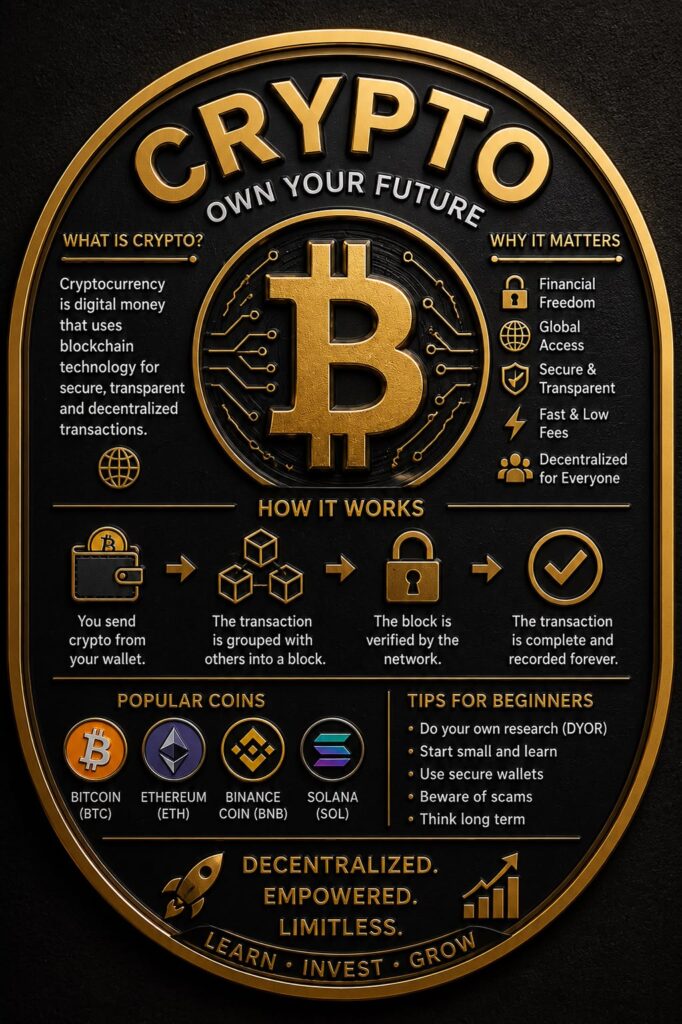
Cryptocurrency is a type of digital asset designed to operate using cryptographic techniques. Many cryptocurrencies use blockchain technology, which maintains a record of transactions across a network of computers.
Unlike traditional currencies issued by central banks, many cryptocurrencies operate on decentralized networks. This means that no single organization necessarily controls the entire system.
Bitcoin, for example, is a cryptocurrency designed to enable digital transfers without requiring a central authority to process every transaction. Ethereum is another well-known cryptocurrency network that supports digital payments and applications built using smart contracts.
However, not every cryptocurrency operates in the same way. Some projects have more centralized control, different technical designs, or specific purposes.
Cryptocurrency is also different from money held in a conventional bank account. Its value may fluctuate significantly, and protections available for traditional bank deposits may not apply.
Understanding these differences is the first step toward making informed decisions.
2. How Does Cryptocurrency Work?
To understand cryptocurrency, it helps to become familiar with a few basic concepts.
Blockchain Technology
A blockchain is a type of digital ledger that records transactions in a structured sequence of data blocks.
Copies of the ledger may be maintained by multiple computers participating in a network. Depending on the blockchain, transactions are validated through mechanisms such as proof of work or proof of stake.
Once transactions are sufficiently confirmed, changing previously recorded information can be difficult or costly.
However, blockchain technology does not automatically make every cryptocurrency safe, legitimate, or profitable. Fraudulent projects can still use blockchain networks.
Cryptocurrency Wallets
A cryptocurrency wallet is a tool that allows you to manage the cryptographic keys used to access and authorize transactions involving your digital assets.
Wallets may be software applications, browser extensions, hardware devices, or other systems.
A wallet does not necessarily store coins in the same way a physical wallet holds cash. Instead, it helps you interact with the blockchain.
Some wallets are controlled directly by the user, while others are managed by a cryptocurrency exchange or service provider.
With a self-custody wallet, protecting your private keys or recovery phrase is critical. Anyone who obtains the necessary credentials may be able to access your assets.
Cryptocurrency Exchanges
Cryptocurrency exchanges are platforms that allow users to buy, sell, or exchange digital assets.
Some operate through centralized companies, while decentralized exchanges use blockchain-based systems to facilitate transactions.
Before using an exchange, investigate its reputation, security practices, fees, withdrawal policies, and legal status in your jurisdiction.
Remember that leaving cryptocurrency with a service provider introduces risks associated with that provider, including account restrictions, security breaches, and insolvency.
3. The Potential Benefits of Cryptocurrency
Cryptocurrency offers several potential benefits, although these advantages vary depending on the asset, network, and circumstances.
Accessibility
Cryptocurrency networks may allow people to transfer digital assets without relying on traditional banking infrastructure for every transaction.
This can be useful for people who need access to certain digital financial services, although buying, selling, and converting cryptocurrency into local currency may still require regulated intermediaries.
Access to a cryptocurrency network also does not eliminate the need for internet connectivity, suitable technology, or an understanding of the risks.
International Transfers
Some cryptocurrency networks can process transfers across national borders without using the same intermediaries involved in conventional international bank transfers.
Depending on the network and service provider, this may offer advantages in speed or cost.
However, transaction fees, confirmation times, exchange rates, and conversion costs vary. Cryptocurrency transfers are not always cheaper or faster than traditional payment methods.
Financial Innovation
Cryptocurrency technology has helped create new financial applications, including decentralized exchanges, digital lending protocols, tokenized assets, and programmable payment systems.
These developments have expanded experimentation with how digital assets and financial services can operate.
Nevertheless, new technology can introduce additional technical, financial, and regulatory risks.
Potential Investment Opportunities
Some investors purchase cryptocurrency because they believe certain digital assets may increase in value over time.
Early investors in some successful cryptocurrencies have experienced substantial gains, but others have suffered significant losses.
Past performance does not guarantee future returns, and there is no assurance that any cryptocurrency will retain its value.
Cryptocurrency should therefore be approached as a risky asset rather than a guaranteed way to build wealth.
4. The Major Risks of Cryptocurrency
Understanding the risks is especially important for beginners because cryptocurrency losses can happen quickly.
Extreme Price Volatility
Cryptocurrency prices can rise or fall dramatically within short periods.
An asset that increases significantly in value today may lose a large portion of its value tomorrow.
For example, if you invest ₦100,000 in a cryptocurrency and its market price falls by 40%, your investment would be worth approximately ₦60,000 before transaction costs, assuming the asset tracks that price change.
This volatility can make cryptocurrency unsuitable for money you need for rent, food, education, medical expenses, or other essential obligations.
Scams and Fraud
Cryptocurrency scams may involve fake investment platforms, fraudulent giveaways, impersonation, romance scams, phishing messages, or promises of guaranteed returns.
Some scammers claim that investors can earn unusually high profits with little or no risk. Others pressure people to transfer cryptocurrency urgently or recruit friends and family.
Be particularly cautious of anyone who promises guaranteed daily profits or demands additional payments to release supposedly frozen funds.
Legitimate investments involve risk, and no trustworthy provider can guarantee consistently high cryptocurrency returns.
Irreversible Transactions
Many cryptocurrency transactions cannot easily be reversed once confirmed.
If you send assets to the wrong address or transfer funds to a scammer, recovering the money may be difficult or impossible.
Always verify the recipient’s address, network, and transaction details before sending funds. When appropriate, consider making a small test transfer before transferring a larger amount.
Security and Custody Risks
Cryptocurrency holders may lose access to their assets if they lose their private keys or recovery phrases.
Exchange accounts can also be compromised, and service providers may experience outages, withdrawals restrictions, or financial difficulties.
Use strong, unique passwords, enable multi-factor authentication where available, and keep recovery information private.
Never share your recovery phrase with anyone claiming to offer technical support.
Regulatory and Legal Uncertainty
Rules governing cryptocurrency vary by country and can change over time.
Some jurisdictions impose restrictions on cryptocurrency trading, payments, advertising, or the activities of service providers.
Tax obligations may also apply to cryptocurrency transactions, depending on local law.
Before investing, check the current rules and guidance issued by the relevant financial and tax authorities in your country.
5. What Beginners Should Know Before Investing
If you decide to explore cryptocurrency, take time to prepare rather than rushing into a purchase.
Start with education. Learn how the asset works, what problem it is intended to solve, how its network operates, and what factors may influence its price.
Only risk money you can afford to lose. Do not use borrowed money or funds reserved for essential expenses. Even established cryptocurrencies can experience severe losses.
Understand every fee. Exchanges and payment providers may charge trading, deposit, withdrawal, or conversion fees. Network transaction fees may also apply.
Research before buying. Examine the project’s documentation, development activity, token supply, governance structure, and potential conflicts of interest. Be skeptical of promotional claims and anonymous recommendations.
Avoid emotional decisions. Fear of missing out can encourage people to buy assets after dramatic price increases. Panic can also lead to selling during sudden market declines.
Protect your personal information. Use official websites and applications, verify links carefully, and never disclose passwords or recovery phrases.
Diversify thoughtfully. Concentrating all your savings in one cryptocurrency can expose you to substantial losses. Diversification across investments may reduce some risks, although it cannot eliminate market risk.
6. Should You Invest in Cryptocurrency?
Cryptocurrency is not suitable for everyone.
It may appeal to people who understand the technology, can tolerate substantial price fluctuations, and have already considered their broader financial priorities.
However, if you have high-interest debt, no emergency savings, or difficulty meeting essential expenses, strengthening your financial foundation may be a more appropriate priority.
You do not need cryptocurrency to achieve financial stability or build long-term wealth. Conventional savings products and diversified investments may be more suitable depending on your goals, risk tolerance, and local financial options.
If you choose to invest, consider starting with education and observation rather than immediately committing money. You can study market behavior and learn how transactions work before deciding whether the risks are acceptable.
7. Common Cryptocurrency Myths
Several misconceptions can lead beginners to make poor decisions.
Myth 1: Cryptocurrency always produces high profits.
Reality: Prices can rise dramatically, but they can also fall sharply. Investors can lose some or all of the money they invest.
Myth 2: Cryptocurrency is completely anonymous.
Reality: Many public blockchains record transactions that can be examined and sometimes linked to individuals through additional information.
Myth 3: Every cryptocurrency is a good investment.
Reality: Projects vary considerably in usefulness, security, transparency, and financial sustainability. Some tokens have little practical value or are created primarily for speculation.
Myth 4: A higher-priced coin is always a better investment.
Reality: The price of one token does not reveal the overall value of a cryptocurrency project. Supply, market capitalization, demand, token distribution, and other factors matter.
Myth 5: You must invest immediately to avoid missing out.
Reality: Cryptocurrency markets will continue to involve opportunities and risks. Taking time to understand an investment is generally better than making a rushed decision.
Conclusion
Cryptocurrency is an evolving part of the digital financial world. It offers potential benefits, including new ways to transfer digital assets, experiment with financial technology, and access speculative investment opportunities.
However, it also involves substantial risks, including extreme volatility, scams, security problems, irreversible transactions, and regulatory uncertainty.
For beginners, the best approach is to learn the fundamentals, research carefully, protect personal information, and avoid investing money needed for essential expenses.
Most importantly, do not confuse popularity with safety or the possibility of high returns with a guarantee of success.
The smartest first step in cryptocurrency is not buying your first coin. It is understanding what you are buying, what could go wrong, and whether the risk makes sense for your financial situation.