Introduction
Investing is one way people try to grow their money and achieve financial security. Individuals invest in businesses, stocks, bonds, real estate, and other opportunities with the hope of earning profits over time. However, not every investment opportunity is genuine. Some individuals and organisations use dishonest methods to trick people into giving them money. These dishonest schemes are known as investment scams.
Investment scams occur when fraudsters deceive people by promising unrealistic profits, providing false information, or hiding the risks involved in an investment. Victims may lose their savings, borrow money to invest, or even experience serious financial difficulties. Investment scams can affect anyone, regardless of age, education, occupation, or income level.
Learning how to identify investment scams and protect your money is essential for making informed financial decisions. By recognising warning signs, checking investment providers, and avoiding unnecessary risks, individuals can reduce their chances of becoming victims of financial fraud.
Meaning of Investment Scams
An investment scam is a fraudulent scheme designed to persuade people to invest money based on misleading claims or false promises of financial returns. Scammers often present themselves as experienced investors, successful businesspeople, financial advisers, or representatives of legitimate companies.
They may advertise opportunities through social media, messaging applications, websites, phone calls, emails, or face-to-face meetings. Some even use fake documents, testimonials, and fabricated account balances to make their schemes appear legitimate.
The main objective is usually to obtain money from unsuspecting investors. Once they have collected enough funds, the scammers may disappear, stop responding to messages, or invent excuses for refusing withdrawals.
How to Identify Investment Scams
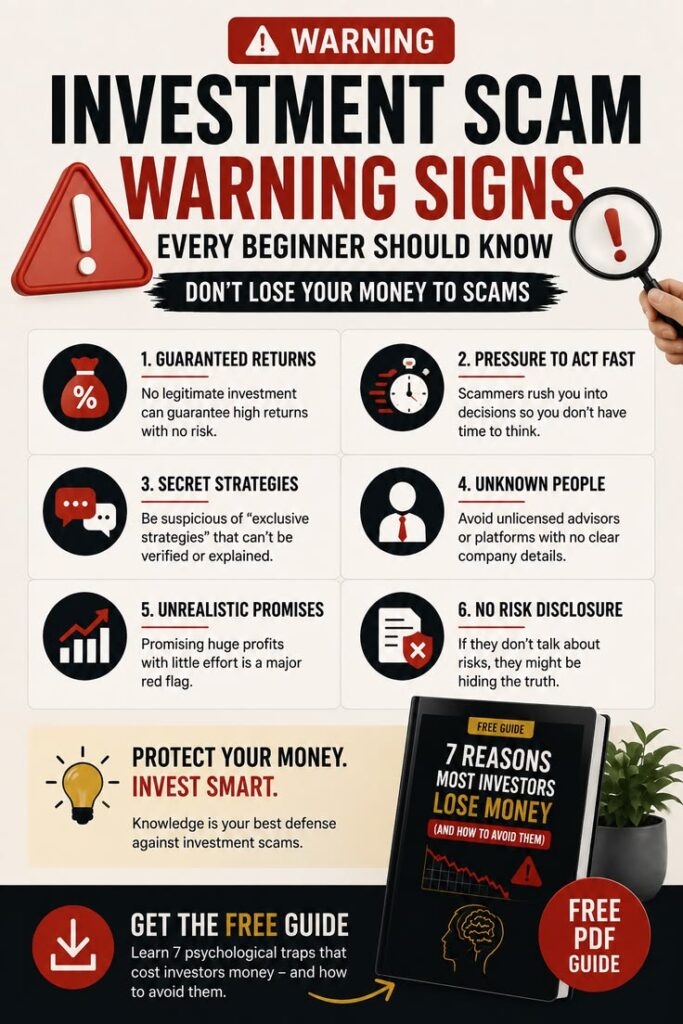
1. Unrealistic Promises of High Returns
One of the most common warning signs of an investment scam is a promise of unusually high profits with little or no risk.
For example, someone may claim that investing ₦100,000 will guarantee a return of ₦200,000 within one week. Genuine investments carry risks, and their returns are rarely guaranteed at unusually high levels over short periods.
Scammers use attractive promises to create excitement and encourage people to invest quickly. Investors should be cautious whenever the promised profits seem too good to be true.
2. Guaranteed Profits With No Risk
Every legitimate investment involves some form of risk. The value of stocks may fall, businesses may fail, and property prices may decline.
Therefore, anyone who promises guaranteed profits without explaining the risks should be treated with caution. A person claiming that an investment can never lose money may be attempting to deceive potential investors.
Before investing, ask how the returns are generated, what risks are involved, and whether the investment can lose value.
3. Pressure to Invest Immediately
Fraudsters often pressure people to make quick decisions. They may claim that an opportunity will close within hours or that only a few spaces remain.
This tactic is designed to prevent potential investors from conducting proper research or seeking independent advice.
A legitimate investment opportunity should allow you enough time to understand its terms and risks. Never allow fear of missing out to force you into making a financial decision without adequate information.
4. Lack of Proper Registration and Documentation
Before investing, check whether the company or financial professional is authorised by the relevant regulatory authority.
In Nigeria, investors can consult the Securities and Exchange Commission (SEC) to verify whether an investment operator is registered or authorised for the activities it offers. Depending on the type of financial product, other regulators may also be relevant.
Be cautious if a company cannot provide a verifiable business address, clear contractual terms, reliable contact information, or evidence of appropriate authorisation.
Remember that scammers can copy the names, logos, and registration details of genuine organisations. Verify information independently through official channels rather than relying on documents provided by the promoter.
5. Dependence on Recruiting New Members
Some fraudulent investment schemes operate as pyramid schemes or Ponzi schemes.
A Ponzi scheme uses money collected from new investors to pay earlier investors, creating the false impression that the investment is profitable. A pyramid scheme generally relies heavily on recruiting new participants who pay money into the structure.
These schemes may collapse when recruitment slows down or withdrawals exceed the money coming in.
Be suspicious if an investment mainly rewards you for recruiting friends and family rather than generating income through a genuine business or identifiable economic activity.
6. Unclear Business Activities
A genuine investment should have an understandable explanation of how it operates and generates returns.
Scammers may use complicated financial language, vague business descriptions, or claims involving secret trading strategies to avoid answering questions.
For example, a promoter may claim to earn enormous profits through cryptocurrency trading but refuse to explain the strategy, risks, or source of returns.
Do not invest in something you cannot adequately understand. Seek independent professional advice if necessary.
7. Fake Testimonials and Online Reviews
Investment scammers often display photographs, videos, screenshots, or testimonials showing people who supposedly earned large profits.
However, these materials may be fabricated, edited, or taken from unrelated sources. Fraudsters may also use fake social media accounts to create the impression that many people trust their scheme.
Do not rely solely on testimonials or screenshots of successful withdrawals. Verify the company, its business model, and its regulatory status independently.
How to Protect Your Money
1. Conduct Thorough Research
Before investing, investigate the company, its management, its products, and the source of its promised returns. Search for independent information and check official regulatory records.
Do not assume that a professional-looking website or a large social media following proves that an investment is genuine.
2. Understand the Investment
Read the investment agreement, fee structure, withdrawal conditions, and risk disclosures carefully. Make sure you understand how profits are generated and what could cause you to lose money.
If the promoter refuses to answer reasonable questions, consider it a warning sign.
3. Never Invest Money You Cannot Afford to Lose
Avoid risking money needed for food, rent, education, healthcare, debt payments, or other essential expenses.
Be particularly careful about borrowing money to participate in speculative investments. Even legitimate investments can lose value, and debt can make those losses more damaging.
4. Protect Your Personal and Financial Information
Never share your banking PIN, password, one-time password (OTP), or account recovery codes with an investment promoter.
Use strong, unique passwords and enable additional account security where available. Avoid sending money to personal accounts unless you have independently verified the recipient and the legitimacy of the transaction.
5. Diversify Your Investments
Avoid putting all your savings into one company, asset, or investment opportunity. Diversification spreads your money across different investments and may reduce the impact of a loss in one area.
However, diversification does not eliminate risk, and spreading money across several fraudulent schemes will not protect you. Verify every investment before committing funds.
6. Be Careful With Social Media Offers
Investment advertisements on WhatsApp, Facebook, Instagram, Telegram, and other platforms may be misleading or fraudulent.
Do not assume an offer is genuine because it was shared by a friend or appears in a familiar online group. Even trusted accounts can be compromised.
Always verify the opportunity independently before sending money.
What to Do If You Suspect an Investment Scam
If you believe you have encountered an investment scam, stop sending money immediately. Keep copies of payment receipts, messages, account details, contracts, and other relevant evidence.
Contact your bank or payment provider as soon as possible to report the transaction and ask whether it can be stopped, reversed, or traced. Recovery is not guaranteed, but acting quickly may help.
In Nigeria, you can report suspected investment fraud to the SEC when it involves securities or investment operators. You can also report suspected criminal fraud to the appropriate law enforcement authorities, including the Nigeria Police Force or the relevant cybercrime reporting channels.
Be cautious of people who promise to recover your lost money in exchange for an upfront fee. Recovery scams frequently target people who have already been defrauded.
Conclusion
Investment scams are a serious financial threat because they exploit people’s desire to grow their money and improve their lives. They often involve unrealistic returns, guaranteed profits, pressure to invest quickly, false registration claims, and schemes that depend on recruiting new participants.
Protecting your money requires patience, research, independent verification, and careful financial planning. Always understand an investment before committing funds, safeguard your personal information, and avoid making decisions based on pressure or excitement.
Most importantly, remember that a genuine investment opportunity should withstand careful questioning and independent verification. Taking time to investigate before investing is far better than risking your hard-earned money on promises that may never be fulfilled.