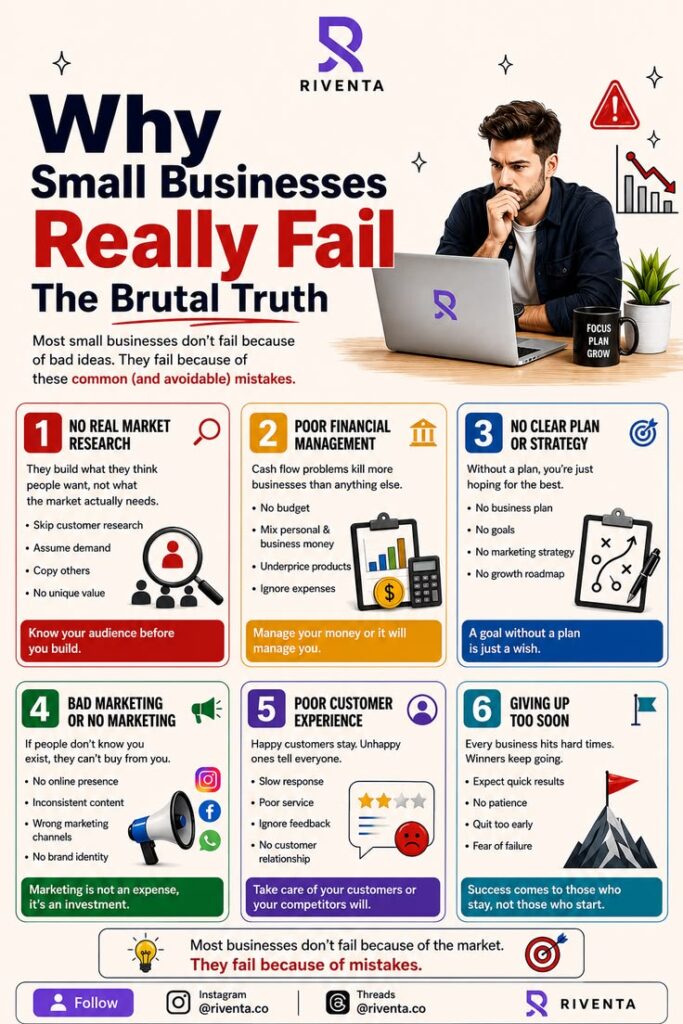
Starting a small business can be an exciting opportunity to earn income, become financially independent, and build something valuable. However, running a business successfully requires more than having a good product or attracting customers. You must also manage your money carefully.
Many small businesses struggle because of financial mistakes that could have been avoided with proper planning and discipline. A business may generate sales but still fail to pay its bills, repay its debts, or purchase new stock. In other cases, poor pricing and uncontrolled expenses gradually reduce profits until the business can no longer survive.
Understanding these mistakes can help business owners protect their money, make better decisions, and build sustainable businesses. Here are five financial mistakes that can cause small businesses to fail and how to avoid them.
1. Mixing Personal Money With Business Money
One of the most common financial mistakes small business owners make is mixing personal finances with business finances. This often happens when owners use money from daily sales to pay household bills, buy personal items, or cover expenses that have nothing to do with the business.
Although this may seem harmless at first, it becomes difficult to determine how much the business earns, how much it spends, and whether it is actually profitable.
For example, imagine that your business generates ₦300,000 in monthly sales. You spend ₦150,000 on stock, ₦50,000 on rent and transportation, and ₦30,000 on other business expenses. If you also withdraw money whenever you need it personally, you may struggle to understand how much is available for restocking or paying upcoming bills.
Over time, the business could experience cash shortages even when sales appear strong.
How to avoid this mistake
- Use a separate bank account or clearly designated account for business transactions where practical.
- Record all business income and expenses.
- Decide how much money you can reasonably withdraw for personal use.
- Avoid treating total sales revenue as personal income.
- Review your business finances regularly.
Separating your finances helps you understand your business performance and makes it easier to plan for growth.
2. Failing to Track Expenses and Create a Budget
Another mistake that can damage a small business is spending money without keeping accurate records or following a budget.
Small expenses may appear insignificant individually, but they can become substantial when accumulated. Transportation, packaging, electricity, advertising, bank charges, repairs, and other operating costs can gradually reduce your profit.
Without records, you may not notice where your money is going until the business begins struggling financially.
For example, suppose your business generates ₦500,000 in monthly revenue. You estimate that your expenses total ₦350,000, but you fail to record several smaller purchases. When you calculate your finances at the end of the month, you discover that actual expenses are ₦420,000.
Your profit is now much lower than expected.
A budget helps you estimate how much money you expect to receive and how you plan to spend it. It also allows you to identify unnecessary expenses before they become serious problems.
How to avoid this mistake
Create a simple monthly budget that includes stock purchases, rent, salaries, transportation, utilities, marketing, taxes, and other relevant costs.
Record every transaction in a notebook, spreadsheet, or bookkeeping application. Keep receipts and invoices where possible.
At the end of each month, compare your actual spending with your budget. Investigate significant differences and adjust your plan when necessary.
You do not need complicated accounting software to get started. The most important thing is to maintain accurate and consistent records.
3. Setting Prices Too Low and Ignoring Profit Margins
Many small business owners believe that offering the lowest prices is the best way to attract customers. Although competitive pricing can help attract buyers, charging too little can make it difficult to cover business expenses and earn a reasonable profit.
The problem often begins when business owners calculate only the cost of purchasing a product and ignore additional expenses.
For example, suppose you buy an item for ₦5,000 and sell it for ₦6,000. At first glance, you appear to earn ₦1,000 per sale.
However, if packaging, transportation, payment fees, and other costs add another ₦700, your remaining gross profit is only ₦300 before other overhead expenses.
If you also pay rent, electricity, or staff salaries, the business may struggle to make a sustainable profit.
Low prices can also force you to sell more products than your available resources can support.
How to avoid this mistake
Calculate the full cost of providing each product or service. Include direct costs and a reasonable allocation for operating expenses.
Research competitors, but do not copy their prices without understanding your own costs. Your competitors may have different suppliers, lower overheads, or different business models.
Set prices that customers can reasonably accept while allowing your business to cover expenses and generate profit.
Review your prices when supplier costs, transportation expenses, or other operating costs increase. Remember that making many sales is not enough if each sale contributes too little toward sustaining the business.
4. Poor Cash Flow Management
Cash flow refers to the movement of money into and out of a business. Poor cash flow management can cause serious problems, even when a business appears profitable.
A business needs available cash to pay suppliers, workers, rent, utilities, and other obligations when they become due.
Imagine that you sell products worth ₦400,000 to customers who promise to pay later. You may recognize revenue from those sales, depending on the applicable accounting rules, but you cannot use the unpaid invoices to purchase stock or pay your bills immediately.
If your suppliers require immediate payment, you may experience a cash shortage while waiting for customers to pay.
Other cash flow problems can arise from buying too much inventory, spending heavily on expansion, or failing to prepare for periods of low sales.
How to avoid this mistake
Prepare a cash flow forecast showing the money you expect to receive and pay over the coming weeks or months.
Follow up on overdue customer payments and establish clear payment terms. Avoid tying up too much cash in products that sell slowly.
Plan for upcoming expenses and maintain a financial reserve when possible. Before expanding your business, ensure that you can afford the additional costs without jeopardizing essential operations.
Understanding the difference between cash flow and profit is particularly important. Profit measures financial performance, while cash flow helps you understand whether money is available to meet immediate obligations.
5. Taking on Too Much Debt or Expanding Too Quickly
Debt can sometimes help a business purchase equipment, increase inventory, or take advantage of a valuable opportunity. However, borrowing more than the business can comfortably repay can create serious financial pressure.
Problems arise when owners take expensive loans without a clear repayment plan or borrow money simply to maintain an appearance of success.
Expanding too quickly can create similar difficulties. Renting a larger shop, hiring additional workers, purchasing expensive equipment, or opening another branch increases operating costs.
If sales do not grow enough to support these expenses, the business may struggle to pay its bills.
For example, a business owner might borrow ₦1 million to expand operations based on expected sales. If customer demand is lower than anticipated, loan repayments and additional operating costs can consume the available cash.
How to avoid this mistake
Before borrowing, calculate the total repayment amount, interest charges, fees, and repayment schedule. Consider whether your business can meet these obligations even if sales decline temporarily.
Use borrowed money for a clearly defined purpose and evaluate how that investment is expected to benefit the business.
Expand gradually when possible. Test customer demand, review your financial performance, and ensure that your existing operations are stable before committing to major additional expenses.
Avoid assuming that higher sales will automatically produce higher profits. Growth should be supported by realistic financial projections and sufficient working capital.
Conclusion
Small businesses can fail for many reasons, but financial mistakes often make existing challenges worse. Mixing personal and business money, failing to track expenses, setting prices too low, neglecting cash flow, and taking on excessive debt can gradually weaken a business.
The good news is that these problems can often be reduced through better financial habits.
Start by separating your finances, keeping accurate records, preparing a realistic budget, and understanding your profit margins. Monitor cash flow carefully, borrow responsibly, and expand only when your business is financially prepared.
You do not need to be an accounting expert to manage your business finances effectively. You need accurate information, consistent planning, and the willingness to make informed decisions.
Remember, a successful small business is not built on sales alone. It also depends on how wisely you manage the money those sales generate.